
ALARM! EVACUATION! ASSEMBLY! What next?
If you’re a Safety Professional and in charge of emergency evacuation management (a.k.a Evacuation Warden, Fire Warden, Evacuation Manager, Evacuation Officer, etc.), you know exactly what comes after the emergency alarm sounds.
The United States Department of Labor and the Occupational Safety and Health Administration (OSHA) require companies with ten (10) or more employees to maintain a written Emergency Action Plan (EAP). And a critical part of that plan is being able to quickly account for every employee, contractor, and visitor on site.
Why Being Ready is Important
An emergency evacuation is the urgent, immediate egress of people from buildings or areas facing an imminent threat or potential hazard to life or property. The most common events are natural disasters and workplace accidents: fires, explosions, chemical spills, and smoke. Safety managers should plan for human-caused dangers too, such as active shooters, bomb threats, and terrorism.
No matter how many drills your team has run, a real evacuation is unpredictable. Panic, confusion, and chaos set in fast. Personnel may be hurt, disoriented, or unable to move on their own. The margin for error is zero.
Large Facilities Require More Than a Paper Roster
It could be easy to take a headcount of a handful of employees in a small workplace. Employers with large or enterprise facilities and a large number of people onsite, however, need to take emergency preparedness very seriously. These workplaces might include:
- Oil and Gas Refineries
- Chemical Plants
- Mines
- Military Bases
- Manufacturing Sites
- Government Facilities
- Multi-story Corporate Offices
- Construction Sites
- Airports
- School or Universities

Workplaces come in all different shapes and sizes. Evacuation procedures differ for each one, but the goal is the same: ensuring people are safe and accounted for.
OSHA’s requirement is clear: “account for everyone during an emergency evacuation”. In practice, it’s harder than it sounds. The number of assembly points required depends on a facility’s size, layout, and occupancy count. If assembly points are widely spaced, communication and coordination among multiple evacuation leaders can get complicated. Now, picture accounting for an entire workforce with just a paper roster, a pen, and a clipboard. Who got out safe? Who’s still missing? In a real emergency, there is no room for uncertainty.
How an Emergency Mustering System Replaces the Clipboard
Automated roll call and muster-point accountability tools can help ensure everyone’s safety in an emergency. Large facilities already use access control systems to secure the workplace and track who badges in and out. That occupancy list can be leveraged for emergency headcounts if you can get the data to the muster point.
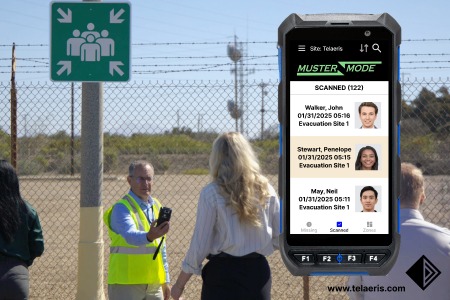
XPressEntry does just that. Handheld badge readers mobilize access control data in the field to streamline emergency evacuation management and accountability tracking. Here’s how:
- Integrate XPressEntry with the company’s existing access control system to pull the latest occupancy information and badge data
- Rapidly scan badges with handheld readers at assembly areas to account for employees
- Anyone without a badge can be quickly found in the occupancy list and marked as safe
- Provide a list of missing employees to first responders on the scene, with photos, names, and last known locations based on access control data
- All handheld readers in the field stay in sync with each other and the access control system
Benefits of Mobile Emergency Mustering Software

There are many types of mustering software systems, including stationary readers, screenless readers, and mobile applications. The right solution for a facility will depend on the nature of the site’s complexity and infrastructure.
XPressEntry is built for facilities that want to leverage their access control investment. XPressEntry handheld readers have been deployed for mustering at refineries, energy sites, manufacturing plants, corporate buildings, hospitals, labs, data centers, airports, government sites, universities, and more.
Here’s what sets XPressEntry apart:
- Account for hundreds of people in minutes from anywhere on site
- Supports offline mustering; all activity syncs automatically when connectivity is restored
- Scalable and flexible; easily move assembly points to new locations with no disruption to headcount
- Muster Dashboard module available for real-time evacuation tracking on a facility map view
- More physical access control integrations than any other solution in the industry
- Reads the widest variety of security badges in the industry, including mobile credentials and biometrics
- Gives first responders an accurate, customizable list of missing persons with everything they need to act fast: full name, photo ID, employee number, last reader scanned, last zone entered, emergency contact information, and more.
XPressEntry gives safety professionals the tools and flexibility to confidently account for everyone. If you think a handheld badge reader can improve your facility’s emergency accountability process, contact us for a demo.
This blog was originally published on August 27th, 2021, and has been updated to improve accuracy and relevance. Last updated: June 2026