
Cameras, location tracking, and wireless connectivity are all technologies used to strengthen physical security and access control. In highly secure environments, however, these same technologies may be prohibited on portable devices to reduce the risk of sensitive information being recorded or captured by malicious actors.
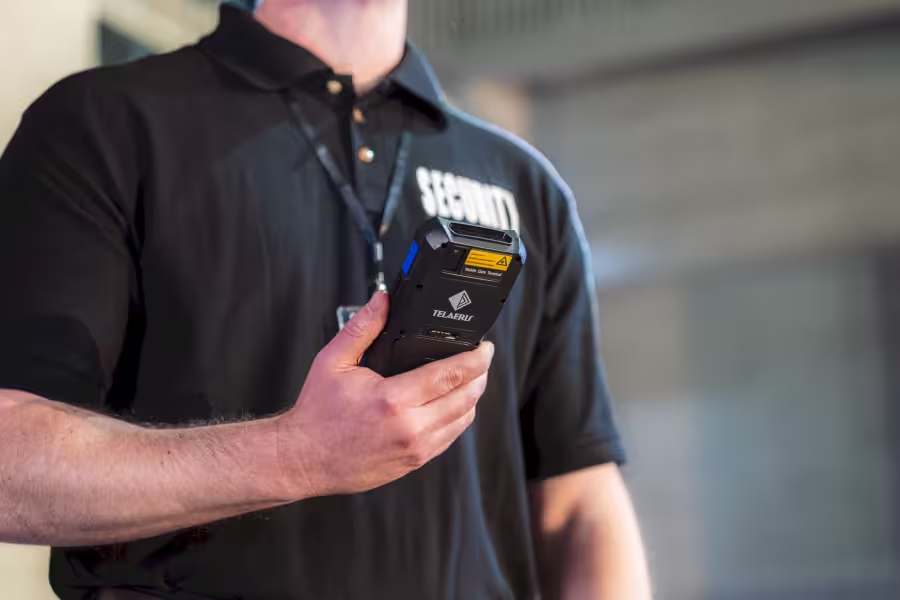
Telaeris has extensive experience deploying handheld badge readers in environments with special requirements. XPressEntry XPID devices are known for their wide range of capabilities, including offline functionality, rugged design, GPS, and more. But this blog covers a more specialized handheld reader stripped of its communication capabilities for use in high-security facilities. These mobile reader devices, referred to as No-Communication or No-Comm devices, are designed specifically for offline access control.
What is a No-Communication Mobile Badge Reader?
No-Comm reader devices have limited or no communication capabilities. This includes features like Wi-Fi, Bluetooth, cellular radios, and cameras. These features are disabled by removing hardware or restricting software, depending on the facility’s requirements. The result is an offline handheld badge reader that cannot transmit or receive wireless signals.
At the hardware level, components may be physically removed from the device, eliminating the security risks these capabilities may expose:
- Bluetooth
- Wi-Fi
- Cellular communication
- Cameras
- GPS functionality
At the software level, Mobile Device Management (MDM) platforms such as SOTI or Microsoft Intune allow administrators to further manage and restrict device functionality, such as:
- locking the device to a specific application
- turning off networking capabilities
- disabling the camera, USB, and other hardware components
Making the distinction between hardware and software configurations is important because the most secure facilities have regulatory restrictions that require complete hardware removal, not just disablements at the software level.
How does a No-Communication handheld badge reader work?
The XPID No-Comm devices sync with a facility’s access control system when docked into their ethernet-enabled cradle. All the latest access control lists and permissions are automatically pushed to the handheld, and any badge activity recorded while offline — timestamped and locally cached — is uploaded back to the access control system.
Where are Secure No-Comm Handheld Readers Needed?
Facilities that require offline devices often handle sensitive information, classified materials, or critical infrastructure. They operate under formal regulations governing which devices are permitted on-site. Some areas may be subject to stricter rules than others, for example, corporate boardrooms, telecom or server rooms, or areas where top-secret intelligence is stored or processed.
Examples of high-security facilities include:
- High-security government buildings
- Military/defense facilities
- SCIFs (Sensitive Compartmented Information Facility)
- Nuclear power plants
- Secure data centers
- Correctional facilities
- Aerospace & automotive engineering labs
These organizations often require mobile access control devices, but without the potential security risks associated with wireless communication technologies. A No-Comm device configuration allows facilities to maintain mobile security operations while remaining compliant with restrictions.

Commonly Deployed Use Cases for No-Comm Handheld Readers
Handheld readers can be used for a number of access-control and safety applications. Ensuring that the people entering a zone are allowed to do so, tracking personnel movement in and out of zones, and spot-checking personnel in high-security zones are a few examples.
Additional applications of secure No-Comm badge readers include:
- Handheld badge validation
- At controlled entry points or for security clearance verification
- Security officers gain visual confirmation of a person’s identity and access level, with their name and photo viewable on the device’s screen
- Entry and exit tracking
- In areas where a fixed reader does not exist or is not feasible, and real-time occupancy tracking is a requirement
- Emergency mustering
- Scan badges at assembly points to account for personnel
- Know who’s safe and who is still inside the building
- Devices operate on locally cached data and don’t depend on a live network connection to function during an evacuation
- Vehicle and gate access
- Parking structures, employee or contractor shuttle buses, guard shacks, and gates
- Visitor or Contractor Management
- Anyone who needs temporary access to specific zones
- Spot Checking Personnel Security Badges
- In large facilities, it is impossible to know everyone.
The benefit of using a purpose-built access control reader over a simple screenless reader lies in the capabilities of the software and the ability to visually verify employee identity information right on the screen.

Case Study: Secure Badge Validation at a European Government Facility
A European government organization needed secure, offline handheld badge readers for employee access tracking. Due to stringent security policies at this facility, wireless communication capabilities such as cellular, Wi-Fi, Bluetooth, GPS, and cameras were prohibited throughout certain areas.
The organization was previously using devices from another vendor that had reached end-of-life. This led to an urgent need to acquire upgraded, replacement devices on a strict project timeline. The organization’s security integrator recommended Telaeris as a solution and rapidly deployed 50 XPID200 No-Comm handheld readers running XPressEntry. The XPressEntry software leveraged the facility’s existing access control system database, supporting approximately 100,000 badge holders.
With this deployment, security personnel could use the handhelds to validate credentials and manage entry and exit across multiple controlled access points. The no-comm configuration extended mobile access control capabilities across the site while fully satisfying device restrictions. And by integrating with the existing access control system, the government organization effectively replaced its previous system without any significant infrastructure change. After a successful deployment, the organization is looking to expand XPressEntry usage across 170 physical sites.
Similar XPressEntry deployments with XPID No-Comm devices have been completed at confidential facilities and government sites across Europe, the Middle East, and North America, enhancing personnel tracking and mustering, while ensuring compliance with device security requirements.
→ Download the case study here
Is a No-Comm Handheld Reader Right for Your Facility?
One thing to note is that all access control information processed through XPressEntry handhelds is encrypted both in transit and at rest. We have had our server and handheld systems penetration (PEN) tested multiple times by both our own Accredited Security Professionals and by our customers. We have certified multiple MDMs and built our own Secure Device Management system to allow customers to restrict app usage on our handhelds. Telaeris takes your cybersecurity seriously. For most of our clients, this is sufficient.
However, there are cases when our customers not only want more, but they need more. XPressEntry No-Comm devices are built specifically for these high-security facilities, including remote locations with limited infrastructure. They can be configured to meet your specific IT and security needs and can read all standard, government, and or legacy credentials. And with no wireless communication, there is zero risk of exfiltrating information as our No-Comm devices are configured to operate independently and offline. So if you have to be absolutely, 100% certain that there is no leakage over the air, our No-Comm devices might be the right choice for you.
If your facility is seeking an ultra-high-security mobile access-control solution that integrates with your existing access control system or operates as a standalone system, contact us to learn more about XPressEntry’s No-Comm handheld solution configuration.