
Every workplace has its own unique set of risks. But not every emergency is handled the same way.
I recall being in Louisiana with a customer who came to us needing an emergency response system. However, they were trying to solve two distinct problems. The EHS team’s top priority was a solution that would warn people to move to a shelter-in-place location to protect them from inclement weather events.
More urgently, this customer had a disgruntled ex-employee who could be considered an active threat, so they wanted to alert employees to lock down external and office doors if this person showed up.
Both situations required alerting employees to an emergency, but the response to each was completely different. You wouldn’t want people out and moving to a shelter with an active threat on premises!
OSHA requires a business’ Emergency Action Plan to include procedures to account for all employees after an evacuation (29 CFR 1910.38). Unfortunately, this applies to “fire or other emergency” events, and life can be a whole lot more complicated.
Worse, a global 2024 risk management study found that roughly 20% of organizations had no written emergency preparedness plan. This blog is designed to give employers some food for thought to consider for different types of emergencies, both when writing their plan and thinking about the types of hazards that they should consider on the path to keeping their employees safe.
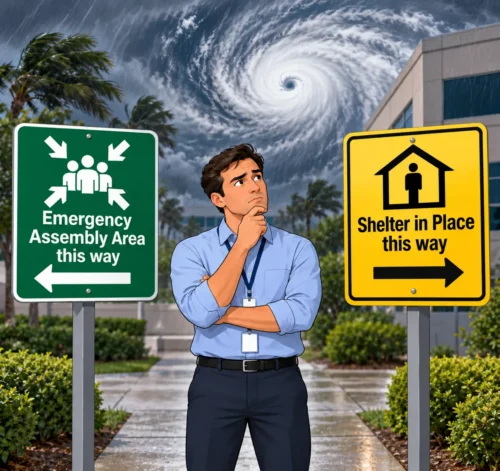
Evacuation Procedures by Emergency Type
There are 2 main ways to assemble in an emergency:
- Evacuate to an assembly area or muster point on site or off site
- Shelter in place in an interior room or safe area until the threat is gone.
Whether a shelter-in-place or traditional evacuation is called for depends on the situation. Both scenarios require obtaining a list of names of everyone present/missing.
Fire
This is the emergency that everyone has prepared for since grade school. People evacuate to an external muster point, and a head count is taken at the assembly area. Seems simple, but many plans still fail. If a drill takes longer than expected, identify what gaps are keeping you from accounting for people more effectively.
Chemical/Gas Leak
A hazmat emergency creates physically hazardous or toxic environments and will require either an evacuation or shelter in place, whichever keeps personnel farthest away from danger. Personnel may need to be separated if they were exposed vs. unexposed. In some cases, it may be safer to stay inside (shelter in place) if chemical, biological, or radiological contaminants were released into the environment outdoors at or near the place of business or worksite.
Active Threat
People shelter in place in secured, locked rooms. Accountability happens during the lockdown and after law enforcement gives the all-clear.
Severe Weather (hurricane, tornado)
Often there is advance notice of the oncoming weather event. For tornadoes, people head to interior shelter areas or basements. Before a hurricane, many workplaces close early and send staff home.
Flood
For floods, evacuate to high ground or safe off-site locations and check local flood zones and maps to help guide coordination. Sites outside a flood zone should still have an evacuation and accountability plan, as damage can occur outside high-risk zones.
Earthquake
There’s usually little to no warning before an earthquake. Rather than evacuation, the process is to shelter immediately (drop/cover/hold) and take headcounts when shaking stops. Egress may be warranted if it can be done safely. Collapsing buildings, structural damage, and aftershocks can add complexity and chaos to the situation.
Here’s a table summarizing what an emergency evacuation looks like for each disaster type:
| Emergency | Typical warning | Usual response | Best practices |
| Fire | Little to none | Evacuate to exterior muster points / assembly areas | Digital mustering system |
| Chemical or gas release | Little to none | Evacuate to assembly points or shelter in sealed rooms | Digital mustering system |
| Active threat | Little to none | Lockdown, shelter in place | System that supports self-safety reporting |
| Tornado | About 13 minutes (NOAA) | Shelter in safe interior areas | Look to local weather authorities and notification systems for information |
| Hurricane | 36 hours for immediate evacuation warning 48 hours for potential preparation notice (NOAA) |
Shelter in safe interior areas or close the site & send employees home | Look to local weather authorities and notification systems for information |
| Flood | Minutes to days | Evacuate to high ground, often off site | Look to local weather authorities and notification systems for information |
| Earthquake | Little to none (early warning systems give seconds’ notice) | Shelter or evacuate as needed | Headcount after shaking stops at external muster points |
Accounting for Everyone, Whatever the Emergency
You always need to account for everyone, whatever the emergency. What changes is how and where you take that headcount. Thinking back to our customer in Louisiana, severe weather and an active threat both start with an alert to employees, but the responses were not the same. One required moving people to shelter; the other meant locking doors and staying put.
Start by listing the hazards your site actually faces. Decide whether each one calls for evacuating or sheltering in place. Then make sure your accountability process works in both cases. The accountability method may change for each type of emergency, but the main goal is always to keep people safe.
For a more comprehensive guide on setting up an emergency action plan for any workplace, check out our free resource: Emergency Evacuation 101
Have a unique or complex emergency scenario that isn’t covered here? Contact us to see how we can help!
