
Why one word means so many different things in access control
“Present a Wiegand card to the Wiegand reader and it will output Wiegand data over Wiegand wiring in a Wiegand format.”
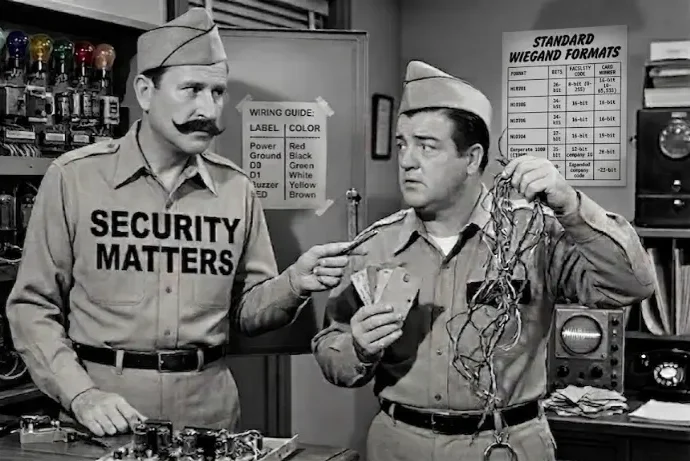
If you’ve spent any time in access control, you’ve either said a version of that sentence or been completely lost by it – or maybe both. This happened recently with an employee, where I realized our conversation was sounding exactly like Abbott and Costello. Wiegand this, Wiegand that, Wiegand the other thing.
You can imagine this exchange in real life:
| Abbott | So the reader reads the badge and sends Wiegand to the panel. |
| Costello | Got it. Wiegand is the badge. |
| Abbott | No, Wiegand is what it sends. |
| Costello | It sends a badge? |
| Abbott | It sends Wiegand data. |
| Costello | Over what? |
| Abbott | Over Wiegand wiring. |
| Costello | It sends a Wiegand wire? |
| Abbott | No, those were in the card. |
| Costello | The Wiegand badge? |
| Abbott | The badge we don’t use. Now use prox. |
| Costello | So Prox is Wiegand? |
| Abbott | No, but Prox data is usually Wiegand formatted. |
| Costello | Ah, so the format is Wiegand! |
| Abbott | Usually 26-bit Wiegand – very common. |
| Costello | So Wiegand comes from the bits? |
| Abbott | The bits are sent over Wiegand wiring, D0/D1. |
| Costello | I thought we didn’t use the wire? |
| Abbott | We don’t – this is wiring. The Wiegand pulses go over the wiring. |
| Costello | The Wiegand wiring is not the Wiegand wire? |
| Abbott | Exactly! |
| Costello | And the pulses come from the badge? |
| Abbott | No – the pulses come from the Wiegand reader. |
| Costello | There someone reading? |
| Abbott | Usually, Wiegand badges. |
| Costello | There is a guy named Wiegand? |
| Abbott | No Wiegand died in 1986. |
| Costello | (long pause) I am going to need the whiteboard. |
And this is the problem: many things are called Wiegand. Given the fact it seems we have to untangle Wiegand with both customers and employees, we clearly need better training material. This article is my attempt to clarify the many different uses of Wiegand. I bet it will be helpful for a lot of other people new to access control as well.
The Many Meanings of Wiegand
The sections of this article are broken down into the different ways you might see Wiegand used.
| Level | What it Actually Refers To | Still Relevant? |
| The Man | John R. Wiegand (1912–1986) | Historical |
| The Effect | A physical phenomenon in specially treated wire | Niche (sensors) |
| The Wire | Vicalloy wire that produces the effect | Niche |
| The Original Wire Card | Swipe cards with embedded Wiegand wires | Obsolete |
| The Interface | The two-wire (D0/D1) electrical signaling standard | Extremely common |
| The Wiring | The common color/pinout convention used with that interface | Extremely common |
| The Formats | Bit layouts carried over the interface (26-bit, Corp 1000, PIV, etc.) | Extremely common |
| Modern Card Usage | Usually Prox/LF cards are called Wiegand Cards today, but integrators will often call HF or even UHF cards “Wiegand” | Everyday speech |
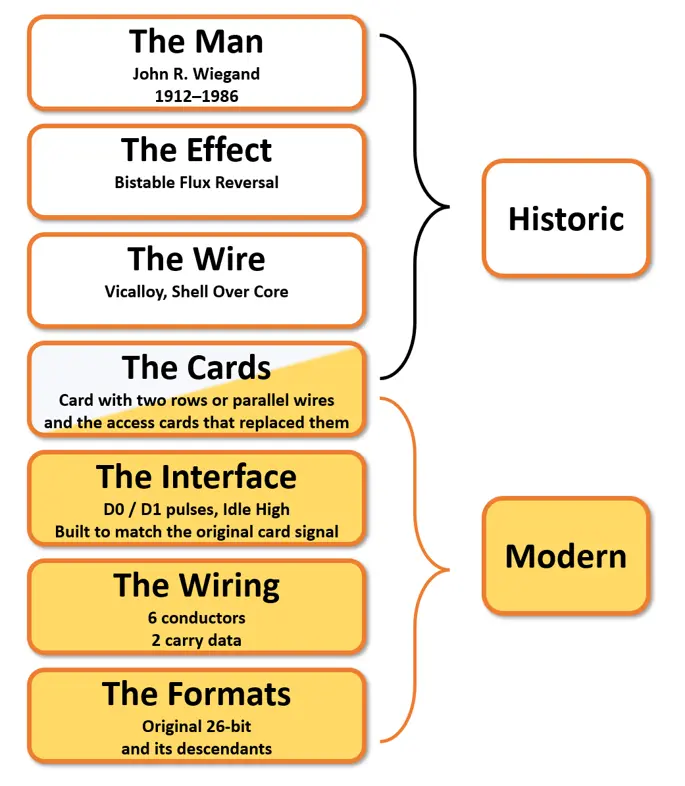
The original card technology died decades ago. The name did not. It simply jumped to the electrical interface, the wiring, the bit formats, and eventually to almost any badge with a reader that sends badge data to an access panel over D0 and D1 data lines.
The rest of this article walks through each layer so the next time someone says “it’s Wiegand,” you’ll know which one they actually mean.
John R. Wiegand, the Man who Heard Magnetism
John Richard Wiegand was born in Germany in February 1912 and emigrated to the United States to study piano and choral conducting at the Juilliard School. At Juilliard, he became interested in the technology behind the music. This curiosity turned into a career working on magnetic amplifiers, starting with Bell Telephone Laboratories. In 1965 he started doing magnetic research on his own, supporting himself with a job as an electronics technician.
While working on his research, Wiegand noticed that by running wires through a loudspeaker, he could hear the pulses they produced and tell them apart by ear – before he had an oscilloscope to look at them with. It certainly helped that he had perfect pitch.
The wires, as he put it, sang to him. He found the effect in the early 1970s, and his bistable ferromagnetic wire was patented in June 1974. Wiegand was awarded a number of US patents using these wires. He died in December 1986, by which point his name was already attached to a card standard and was about to get attached to something that would outlive the card entirely.
The Wiegand Effect: The Magnetic Snap
The Wiegand effect is a physical phenomenon, not a protocol. Take a specially treated ferromagnetic wire, sweep an external magnetic field past it, and nothing happens, the wire holds its existing magnetic state, until the field crosses a threshold. At the threshold, the wire’s magnetization does not drift over. It snaps, reversing its polarity, inducing a consistently fast voltage spike. John Wiegand took a previously known effect, the Barkhausen phenomenon, and with treated wires made it repeatedly detectable. This pulse can be detected by a simple inductive coil, regardless of how fast or slow the field crosses the threshold.
The raw pulse generated by the Wiegand wire is roughly 10 µs, but the reader conditions that pulse into the longer D0/D1 pulse required by the interface. In the original swipe readers, the spacing between bits could vary with swipe speed. Modern electronic readers simply synthesize compliant Wiegand timing.
Wiegand Wire: The Material Behind the Effect
The wire John Wiegand used was Vicalloy – cobalt, iron and vanadium, cold-worked and heat-treated so that a single strand ends up with two magnetically distinct regions. When exposed to a magnetic field, the inner core flips its polarity easily, while the outer shell holds its polarity more strongly. Because the shell resists switching and the core does not, the two regions can be left pointing in opposite directions.
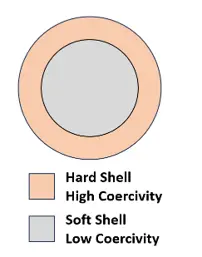
This wire is bistable; exposing it to a magnet allows the core’s polarity to flip quickly while the outer shell remains magnetized, causing a consistent and fast pulse. Keep ramping and eventually the shell flips too, but the shell’s contribution is a much smaller blip. Reverse the field and you reset the wire for the next cycle.
Lengths of these Vicalloy wires are created and used for a variety of purposes. They are remarkably robust, working from roughly −80 °C to 260 °C and are capable of being read from about an inch away.
Wiegand Wire Cards: The Original Credential
At this point, I’m going to specify a distinction.
- Wiegand Wire Card – Cards with Wiegand wires embedded in them – defunct.
- Wiegand Card – Informal industry shorthand for a credential whose identifier is commonly output by a reader using the Wiegand interface – it covers a broad group of modern card technologies – current.
The Wiegand Wire Card is where the effect became an access control product. Short lengths of Wiegand wire are laminated into a badge in two parallel tracks. The wire position from right to left along the card is the bit position and the row indicates the bit value, zero or one. These cards required very specific machinery to produce, which made it hard to create fraudulent cards. The wires would function as long as the card plastic endured. You can see a sample of a card in the figure below from patent US4187981A.
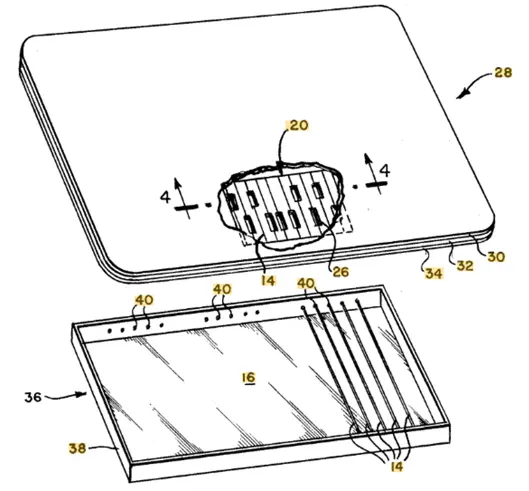
The wires were embedded in plastic credentials and then laminated. The first cards had 26 small wire segments over two rows. You can see an actual Wiegand card creating machine below.
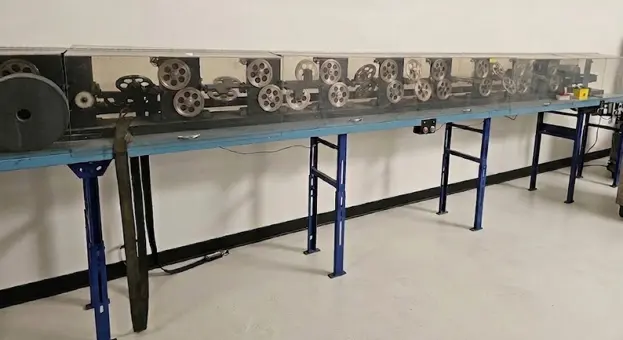
In the 1990s, Proximity RFID cards finally retired the wire technology. But what did not get retired was the name. People in the access control industry started calling 26-bit, 125KHz proximity badges “Wiegand Cards”. And this continues today – ask any access control security integrator to show you a Wiegand Card and they will likely show you a contactless HF or LF technology badge.
The Wiegand Interface: The Standard that Survived
How D0/D1 Signaling Works
The two-wire electrical specification (D0/D1 plus ground) that “Wiegand Wire Card” readers sent out to access control panels is the one true “Wiegand” thing that continues to be true today. This is described in the SIA bulletin SIA AC-01-1996.10 and matches the electrical output that John Wiegand’s wire cards would send over 2 data lines, called Data 0 (D0) and Data 1 (D1).
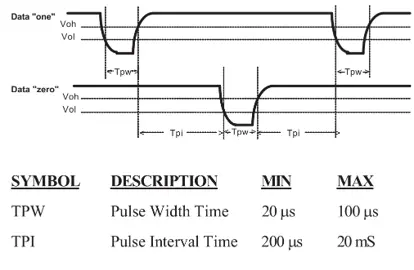
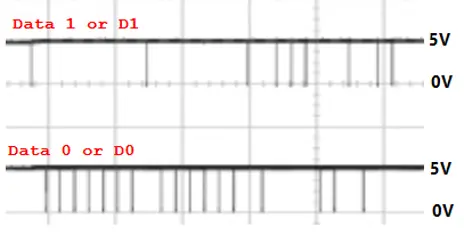
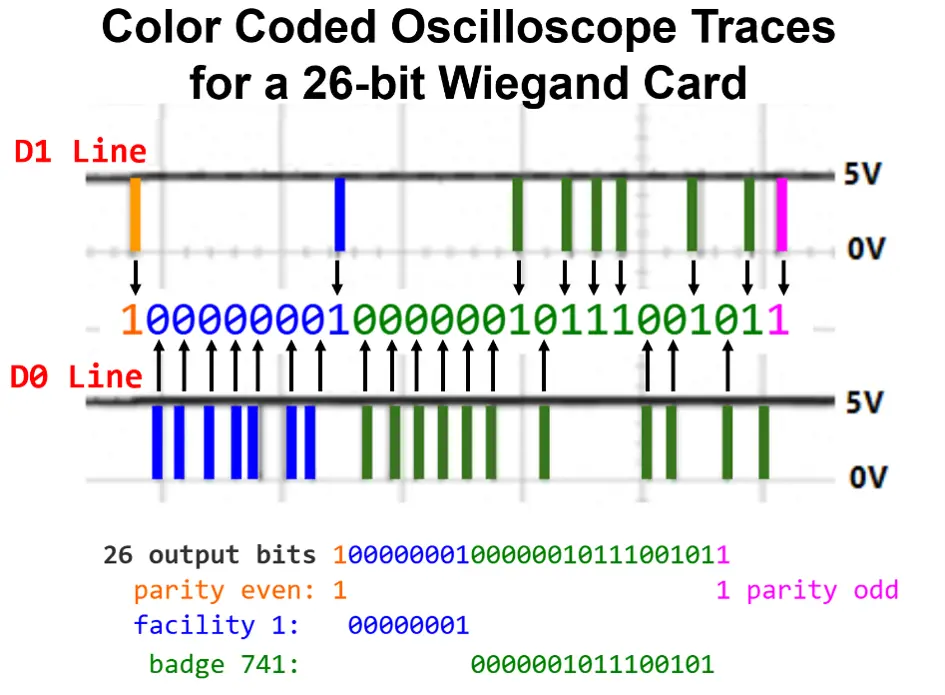
These data lines have no clock. Both are idle high, open-collector outputs, held up to the supply voltage rail, usually +5 VDC, through a pull-up resistor on the panel. To send a zero, the reader pulls D0 low and leaves D1 high. To send a one bit, it pulls D1 low and leaves D0 high. The bits happen sequentially, one line or the other at a time, with timings associated to the Wiegand wire spike and the swipe speed of a card. The SIA bulletin specifies the pulse widths and intervals for the reader – which are not the same as the wire’s roughly 10 µs pulse: the interface timing is set by the specification, not by the physics. Below, you can see an oscilloscope trace of a card presented to a reader with the original 26-bit format.
Simple, Ubiquitous, but Insecure
The interesting thing about Wiegand compliant readers is that they really only support one-way communication. Data is sent from the reader to the panel. The only interaction back is feedback to the user: door opening, reader beeping, LEDs blinking. The simplicity of the interface, and the low cost of building a compatible reader, made Wiegand ubiquitous. The interface provides no authentication or encryption of the D0/D1 data, making the connection vulnerable to interception and replay. This lack of security inspired an updated specification, OSDP. After more than 40 years in existence, panels compliant to the Wiegand specification continue to rule the access control industry – even while the cards have almost completely disappeared.
Wiegand Wiring: The Installer’s View
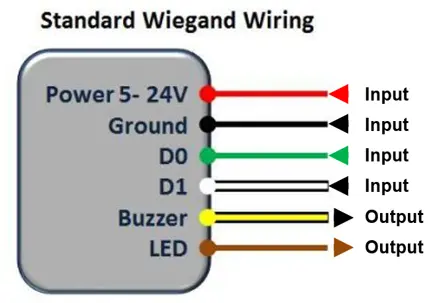
The wiring is the least glamorous Wiegand layer in the cake. When somebody says “Wiegand is the wiring,” they likely are talking about the colors of the wires used to connect a reader to an access panel. The SIA specification defines five conductors: power, ground, D0, D1, and LED. I’ve often seen an additional buzzer line, but have not found this in any specification. The color may be seen in the image below:
Wire these up correctly and your reader will talk to almost any panel. Wiegand wiring on readers is installed by standard low-voltage electricians who typically run 22-AWG multi-conductor stranded cable with an overall shield.
Wiegand Formats: What The Bits Actually Mean
This layer is one of the fun parts of dealing with Wiegand that our engineers get to figure out. The SIA standard mentions the original 26-bit output, but only specifies 24 bits of data – no format at all. The format everyone uses for 26-bit cards is mostly this one: 1 leading parity bit, 8 bits of facility code, 16 bits of card ID, and 1 trailing parity bit. But it is possible that a facility may use a completely different 26-bit layout, including a proprietary or obscured assignment of the data bits.
But with new credentials, card manufacturers built new formats. Here are some examples:
- Casi-Rusco – 40-bit format
- HID 37-bits – Support for many more thousands of card holders
- HID 35-bit Corporate 1000 – Built so formats can be unique per customer
- 200-bit full FASC-N – Used for federal and DoD employees and contractors with their PIV/CAC credentials
This is why someone saying “it’s a Wiegand system” tells someone trying to identify cards from the connected access control system almost nothing useful on its own. This list is by no means exhaustive. Because any number of bits can be sent over Wiegand wiring, many formats have been created and can continue to be created in the future.
How Wiegand Outlived the Wiegand Card
Here is the reason behind forty years of vocabulary trouble. Very quickly competitors to Wiegand readers found they could read data and then emulate the 26-bit Wiegand data using a tiny microprocessor, using the same electric specification. Readers started to appear that were “Wiegand Compatible”, but that read barcodes, magstripes, infrared light through translucent holes in badges, physical bumps, UHF long-range tags, or proximity cards. Each could send data to Wiegand compliant access panels, and the access panel would be none the wiser. And this worked well for end customers who did not want to pay for the massive capital expenditure to replace their existing access panel infrastructure. When proximity cards arrived and killed the Wiegand card, they did not kill the interface.
In fact, our own XPressFreedom board used this “hack”. We read badges on our handheld readers and transmitted it to the Freedom board which sent data on the D0/D1 Wiegand lines. This meant our handheld system could look just like a local reader connected to a panel.
What Wiegand Means Today
Today, you will mostly hear three things called Wiegand.
- Wiegand Card: Any badge (e.g. 125 kHz Prox, 13.56 MHz, UHF, BLE, NFC, barcode, magstripe, PIV, CAC, TWIC) whose reader outputs through a Wiegand Reader Interface.
- Wiegand interface/wiring: The D0/D1 electrical connection between reader and panel.
- Wiegand format: How the bits received by the panel get broken apart (e.g. 26-bit H10301, 35-bit Corp 1000, 37-bit H10302, 37-bit H10304, 200-bit PIV)
A man discovered an effect.
The effect went into a wire.
The wire went into a card.
The card created an interface.
The interface outlived the card.
Then the industry started calling everything Wiegand.
Need Help with Wiegand?
At Telaeris, reading security badges from a handheld is our business. With our partnerships with Elatec, HID, Farpointe and others, we support just about every access control credential in the market, whatever the technology. Our XPressEntry handhelds can read Wiegand credential data, whatever it is, and match cardholders using whatever Wiegand format is used – supporting more than 40 access control systems.
If you have questions about Wiegand – reach out. Our support team is always available – email us at [email protected] and our team will walk through it with you.