
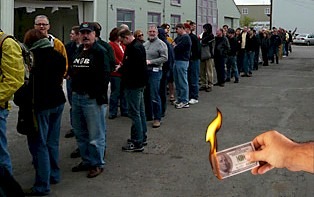
There are lots of hidden costs to doing business, but one you may not think about is the cost of having your employees wait. Waiting for slow computers to boot up, waiting on slow business processes, or what I am going to focus on in this week’s blog – waiting in lines.
Extended wait times are especially inefficient; not only is individual productivity lost, but every subsequent individual in line experiences a compounding delay.
The case that inspired this article involved a client of ours who has a large number of contractors. Every day, they wait in long lines to get their tools before going to their job sites. This client asked us to help speed up this tool checkout process with our software. Together, we listed how waiting in lines negatively affected the company’s bottom line to build internal support for implementing a solution.
Below is a modified version of that list that should apply to most businesses.
Reasons why long employee lines negatively affect businesses:
- Companies still need to pay employees while they stand in lines.
- While employees are in lines, they are not being productive. For example, a construction worker’s time on the job goes down when they spend time waiting in line.
- If employees waiting in lines are repairing a manufacturing process, production will be offline longer, reducing income.
- Long lines may cause a company to hire more people or build more infrastructure to process the line more quickly. Think about checkout registers at grocery stores.
- Long lines can be a source of dissatisfaction. A 2024 report found that consumer frustration with lines rose 126% year over year and that 80% of people avoid businesses with lines altogether. External customers may take their business elsewhere. For employees (who can be thought of as internal customers), frustrating wait times may cause unnecessary job-related stress.
- In more critical situations such as an emergency evacuation, long lines and bottlenecks can become a source of danger or even fatality (if this is a major concern for your business, we provide a dedicated product for optimizing evacuation processes)
These points vary from business to business, but the harm of long lines comes down to reduced satisfaction, potential safety risks, and higher costs. In the consumer industry, long lines cost businesses an estimated $130 billion annually in the United States (ScanQueue, 2026).
We calculated the estimated total savings from reducing wait times. Below is a table showing the savings from reducing each person’s wait time by 2 seconds in a line, for a variety of numbers of employees who might wait in line. It is surprising how quickly the savings increase with the number of employees.
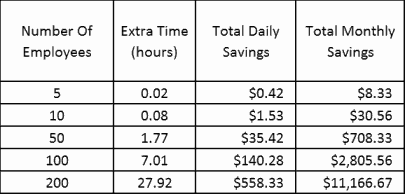
You can download the Excel workbook for this table here.
Back to our specific client’s case: By implementing our XPTrack Inventory Management System (formerly XPressTools), the organization conservatively saved 10 seconds for every 250 workers when they reached the front of the line. When we plugged the rest of this client’s numbers into our worksheet, the raw manpower dollar savings per month came out to close to $200,000.00!

This number did not include other significant savings realized by getting this manufacturing back online faster. With all this information and a clear ROI for the project, implementing our solution not only made sense but also saved a lot of cents.
If you’re looking for a way to optimize
By David Carta, Telaeris CEO This blog was originally posted in September 2011 but has since been updated for clarity and relevance. Last updated: August 2026.
Comments are closed.