
Recently, a customer deploying one of our emergency evacuation systems asked us the following question:
“What is the best way to store our handhelds and tablets to maximize their battery life?”
We wish we could have given this customer a simple answer, but unfortunately, there are many considerations which must be taken into account. As we gathered information for this client, we decided to put together an article to provide as a resource for the community. There is a helpful FAQ for Telaeris XPIDs at the bottom of this blog, but for general battery advice, keep reading.
About Lithium-Ion Batteries
Lithium-ion technology has become the gold standard in the battery industry. Designed to be lightweight, long-lasting and easily rechargeable, lithium-ion batteries are perfect for use in mobile devices. In addition, lithium-ion batteries can maintain a charge when stored for extended periods of time, whereas previous battery technologies would lose charge over a few days. As cell phones and laptops continue to get smaller, more powerful, and lighter-weight, mobile electronics manufacturers turn to lithium-ion as their preferred power source.
With proper use, lithium-ion batteries generally last anywhere from 300 to 500 full charge cycles. After these cycles, their charge capacity is reduced by approximately 20%, and battery life will start to degrade rapidly. A charge cycle is defined as a full discharge to a full charge, which can be made up of multiple partial discharges (i.e. four 25% discharge cycles = 1 full discharge cycle). So, how long should you expect your lithium-ion battery to perform at its optimal level? Here is a simple answer:
If a battery is fully discharged and recharged every day, it will last about one year.
Actual cycle life and capacity loss vary widely with battery chemistry, temperature, usage patterns, and charge habits. This explains why people who use their laptops heavily, often need to replace their batteries frequently. Additionally, battery life for lithium-ion batteries is compromised because they are installed in mobile devices. Physical impacts, vibrations, and variances in temperature cause damage to the battery and shorten the battery’s operational life.
What Can I do to Extend the Life of my Lithium-Ion Battery?
Here are a variety of practices you can carry out to help extend the life and length of charge on your lithium-ion powered handheld, laptop, or smartphone:
- Before first use, apply a full charge to your device. New lithium-ion devices are typically pre-charged to about 50% capacity.
- Lithium-ion batteries do not need a full discharge and recharge to maintain their battery life. In fact, smaller discharges are better.
- Do not allow the battery to be fully discharged for more than one day.
- Do not allow fully charged batteries to sit for extended periods of time (months). If batteries must be stored, store at a 40% charge to prevent loss of capacity.
- When storing for long periods of time, apply a discharge/charge once every 1-3 months.
- Avoid physical impact as this will affect the overall integrity of the battery.
- Avoid temperatures below freezing or above 122 degrees Fahrenheit. For both high and low temperatures, the further the operating temperature is from room temperature the faster the battery degrades.
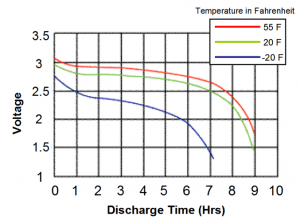
Chart from http://www.mpoweruk.com/performance.htm
- Lithium-ion batteries are prone to overheating, so provide proper ventilation for your device. Ironically, one of the worst things for your laptop is working with it on your lap for an extended period of time. The heat of the battery plus your body temperature can cause your device to overheat. Using the device on a hard surface will allow the heat to better dissipate.
The advice we ultimately provided our client was this rule of thumb; lithium-ion batteries should be replaced at a minimum of once every 18 months and optimally every year. This will ensure your lithium-ion powered device will provide you with a duration of operation that will meet your expectations and requirements.
Below are common questions we get regarding XPressEntry handheld badge readers and their battery life. * Note that the information below applies only to the latest XPID 200 and 210 series readers. Battery capacity, recharge time, and standby duration may differ for older XPID models or other form factors. For information about other devices, please contact Telaeris Support.
XPID Battery FAQs
How long does it take to fully recharge an XPID battery?
Please note: If both the battery inside the handheld and an extra battery in the charger are being charged at the same time, the total charge time will be doubled.
What is the XPID standby time?
Standby time varies depending on usage. Features such as the display, RFID reader, cellular radios, and Wi-Fi all increase power consumption.
XPID 200/210 (5200 mAh): Up to 1,040 hours maximum standby time
Actual battery life will vary depending on usage conditions and enabled features.
What do I do if the XPID lithium-ion battery is swollen?
After several years of normal use, some lithium-ion batteries may swell as the chemicals inside slowly degrade, causing gas buildup and expansion. This can make the battery difficult to insert or remove from the handheld device. Battery swelling is a known issue with lithium-ion technology and can occur as batteries age or experience repeated charge cycles.
If you notice a swollen battery:
-
Discontinue use of the affected battery
-
Do not attempt to puncture or compress it
-
Contact Telaeris Support for battery replacements
We can provide a quote for replacement batteries to keep your XPID handheld running smoothly.
What are the best practices to extend XPID battery life?
-
Avoid frequent full discharges, recharge before the battery drops too low, unplug when charging is complete
-
Keep batteries between 20%–80% charge when possible
-
Avoid extreme heat or cold exposure (Operating Temp: -20°C to 50°C, Storage Temp: -20°C to 70°C)
-
Store batteries partially charged if not used for extended periods
If you have any other questions, reach out to our sales or support teams, who will be ready to help!
This blog was originally published on Jan 15, 2013, and has been updated to improve accuracy and relevance. Last updated: February 2026